
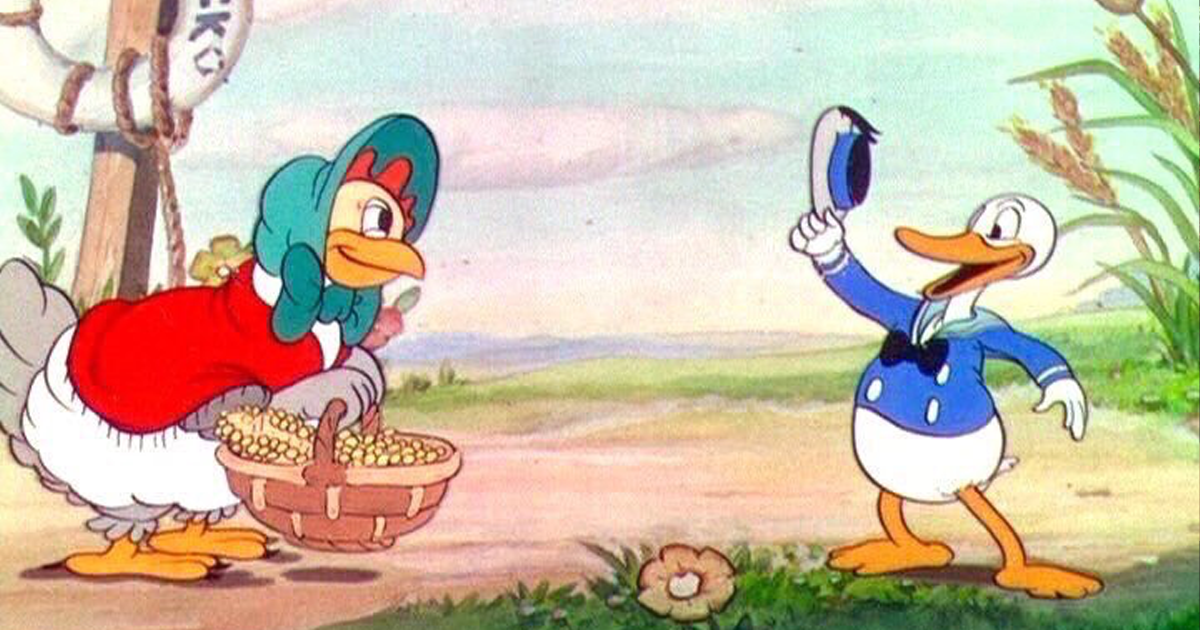
On this day 92 years ago, Donald Duck made his very first film appearance in the Silly Symphony short, The Wise Little Hen, by Walt Disney. Based on a traditional fairy tale, the animated short depicts Donald and his friend Peter Pig attempting to avoid a hard day of manual labor by feigning severe stomach aches. While this short serves as Donald’s official cinematic birth, internal documents from the Walt Disney Archives reveal a much deeper, more complex development process that began years before he ever waddled onto the silver screen.
From an Imitation Goat to a Prototype Duck
Donald’s legendary journey actually began with a vocal parlor trick created by a young performer named Clarence Nash. Nash had originally developed a strange, semi-intelligible voice to imitate a crying baby goat, which he used to entertain friends by reciting nursery rhymes. Walt Disney discovered Nash performing this exact specialty on a local radio commercial and immediately realized the sound would be perfect for a talking duck. Early story outlines preserved in the archives show that the writers initially pictured Donald as a coddled little boy dragged to a party by his mother to recite poetry, a concept that was quickly discarded as The Wise Little Hen took shape.
Dick Lundy and the Evolution of the Design
The physical look of Donald in his 1934 debut, animated by Dick Lundy, bore only a passing resemblance to the global icon we know today. This early prototype features an elongated neck, a long bill, a plumper body, and large, realistic webbed feet that gave him a generic, animalistic appearance. His look remained largely unchanged during his early supporting roles until the summer of 1936, when shorts like Orphans’ Picnic and Moving Day altered his anatomy. Animators shortened his bill to make it more malleable for expressions, enlarged his eyes, and transformed his flat sailor cap into a soft, puffy bean shape, effectively molding him into a distinct individual.
The Birth of the Famous Temperament
While Donald was merely lazy and mischievous in his debut, it was his second film appearance in Orphans’ Benefit later in 1934 that established his defining character trait. When a rowdy audience of orphans heckled his poetry recitation, Donald lost his composure and exploded into a theatrical tantrum. Animator Dick Lundy devised a signature fighting stance for this scene—hopping on one foot and brandishing an aggressive fist—which instantly defined Donald’s comedic identity. Walt Disney recognized that while Mickey Mouse had evolved into a polite, upstanding role model, Donald’s explosive rages were perfectly built for pure slapstick comedy.
Grooming the Ultimate Star
By 1937, Donald’s popularity had completely eclipsed his cartoon peers, prompting the studio to officially launch a dedicated Donald Duck starring series beginning with Don Donald. The Disney studio established a specialized talent pool of story artists and animators known internally as the “Duck men,” who specialized exclusively in crafting Donald’s unique movements and escalating frustrations. This dedicated focus ushered in a golden era of animation where writers subjected Donald to endless daily torments, driving him to the absolute breaking point for the amusement of Depression-era audiences. This relentless work ethic ultimately secured his legacy, propelling him to appear in more theatrical shorts and feature films than any other character in Disney history.
To keep up to date on all the latest Disney news and more, be sure to follow Disney Dorks on Facebook!