
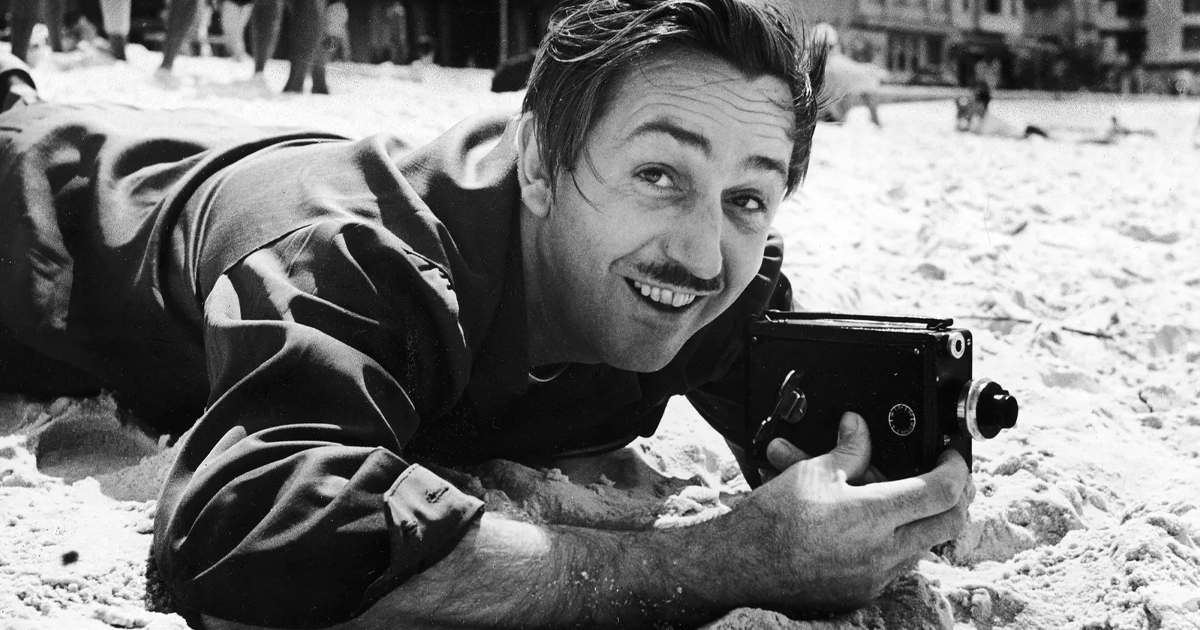
December 5, 1901, marks the birth of Walter Elias Disney. The creator of Mickey Mouse and founder of Disneyland was born in Chicago, Illinois. Walt’s life created the foundation of The Walt Disney Company of today. His visionary spirit and inimitable creativity made the impossible possible.
Childhood and Marceline Influence
Walt was born in a two-story cottage at 1249 Tripp Avenue. He was the fourth son of Elias Disney, an Irish-Canadian, and Flora Call Disney, who was of German-American descent. They named him to honor the family’s pastor and friend, Walter Parr. His siblings were Herbert, Ray, Roy, and Ruth. Roy later became his brother’s essential business partner.
The family moved to a farm near Marceline, Missouri. This time profoundly shaped Walt’s imagination. He became interested in drawing early, selling his first sketches to neighbors when he was only seven years old. The nostalgic feel of Marceline later inspired Main Street, U.S.A.
Education and Red Cross Service
In Chicago, Walt attended McKinley High School. He divided his attention between drawing and photography, contributing both to the school paper. At night he attended the Academy of Fine Arts.
Walt started drawing for the student newspaper in 1917. During the fall of 1918, he attempted to enlist for military service. Rejected because he was only 16, Walt joined the Red Cross. He was sent overseas, where he spent a year driving an ambulance and chauffeuring Red Cross officials. His ambulance was covered from stem to stern with drawings and cartoons. After the war, Walt returned to Kansas City to begin his career as an advertising cartoonist.
The Laugh-O-Grams Failure
Early on, Walt decided to pursue a career in commercial art. This soon led to his experiments in animation. He began producing short animated films for local businesses in Kansas City. Here, in 1920, he created and marketed his first original animated cartoons. He also perfected a new method for combining live-action and animation.
By the time Walt started The Alice Comedies, he ran out of money. His company, Laugh-O-Grams, went bankrupt. The early flop of The Alice Comedies inoculated Walt against fear of failure. He had risked it all three or four times in his life.
The Move to Hollywood
Instead of giving up, Walt packed his suitcase and headed for Hollywood to start a new business. He was not yet twenty-two. In August of 1923, Walt Disney left Kansas City for Hollywood with only a few drawing materials, $40 in his pocket, and a completed animated and live-action film.
Walt’s brother, Roy O. Disney, was already in California. Roy offered immense sympathy, encouragement, and $250. Pooling their resources, they borrowed an additional $500 and constructed a camera stand in their uncle’s garage. Soon, they received an order from New York for the first “Alice Comedy” short. The brothers began their production operation in the rear of a Hollywood real estate office.
Marriage and Family
On July 13, 1925, Walt married Lillian Bounds, one of his first employees, in Lewiston, Idaho. They were blessed with two daughters—Diane and Sharon Disney Lund. Sharon passed away in 1993. Walt’s enthusiasm and faith in himself, and others, took him straight to the top of Hollywood society.
The Birth of Mickey Mouse
Mickey Mouse was created in 1928. His talents were first used in a silent cartoon entitled Plane Crazy. Before the cartoon could be released, sound burst upon the motion picture screen. Thus Mickey made his screen debut in Steamboat Willie on November 18, 1928. It was the world’s first fully synchronized sound cartoon.
Technical Triumphs in Animation
Walt’s drive to perfect the art of animation was endless. Technicolor was introduced to animation during the production of his “Silly Symphonies.” In 1932, the film Flowers and Trees won Walt the first of his 32 personal Academy Awards. He still holds the record for most individual Academy Awards won. In 1937, he released The Old Mill, the first short subject to utilize the multiplane camera technique.
The First Animated Features
On December 21 of that same year, Snow White and the Seven Dwarfs premiered. It was the first full-length animated musical feature. Produced at the unheard-of cost of $1,499,000 during the Great Depression, the film remains an imperishable monument of the motion picture industry. During the next five years, Walt completed classics such as Pinocchio, Fantasia, Dumbo, and Bambi.
World War II Efforts
In 1940, construction was completed on Disney’s Burbank studio. The staff swelled to more than 1,000 artists, animators, story men, and technicians. During World War II, Disney dedicated 94 percent of its facilities to special government work. This included producing training and propaganda films for the armed services. The remainder of his efforts focused on comedy short subjects deemed highly essential to morale.
Live Action and True-Life Adventures
Disney’s 1945 musical feature The Three Caballeros combined live action with the cartoon medium. He successfully used this process in other features such as Song of the South and the highly acclaimed Mary Poppins. The studio released 81 features during his lifetime.
Walt’s inquisitive mind and keen sense for education through entertainment resulted in the award-winning “True-Life Adventure” series. Through films such as The Living Desert and The African Lion, Disney brought fascinating insights into the world of wild animals. He also taught the importance of conserving our nation’s outdoor heritage.
Building the Disneyland Kingdom
Disneyland, launched in 1955 as a fabulous $17 million Magic Kingdom, soon increased its investment tenfold. By its fourth decade, it entertained more than 400 million people, including presidents, kings and queens and royalty from all over the globe.
A pioneer in the field of television programming, Disney began production in 1954. He was among the first to present full-color programming with his Wonderful World of Color in 1961. The Mickey Mouse Club and Zorro were popular favorites in the 1950s.
Walt’s Final Vision: EPCOT
In 1965, Walt Disney turned his attention toward improving the quality of urban life in America. He personally directed the design on an Experimental Prototype Community of Tomorrow, or EPCOT. It was planned as a living showcase for the creativity of American industry.
Disney said, “I don’t believe there is a challenge anywhere in the world that is more important to people everywhere than finding the solution to the problems of our cities… We think the need is for starting from scratch on virgin land and building a community that will become a prototype for the future.”
The Florida Project
Thus, Disney directed the purchase of 43 square miles of virgin land in the center of Florida. Here, he master planned a whole new Disney world of entertainment. This included a new amusement theme park, motel-hotel resort vacation center, and his Experimental Prototype Community of Tomorrow. After more than seven years of master planning and preparation, Walt Disney World opened to the public as scheduled on October 1, 1971. Epcot Center opened on October 1, 1982.
During his 43-year Hollywood career, Walter Elias Disney established himself and his innovations as a genuine part of Americana.
To keep up to date on all the latest Walt Disney news and more, be sure to follow Disney Dorks on Facebook!