
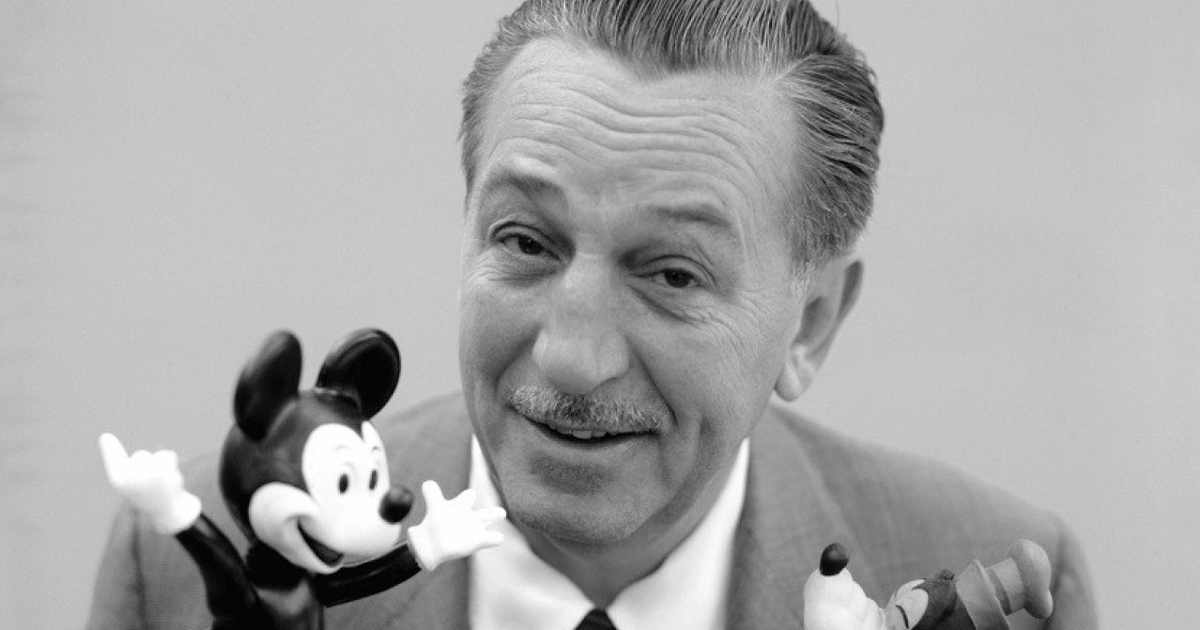
December 15, 1966, marks the day the world lost a legend. Walt Disney passed away at age 65. The visionary’s pioneering spirit and inimitable creativity made the impossible possible. His creativity turned dreams into reality and built the foundation of The Walt Disney Company of today. He died of acute circulatory collapse (caused by lung cancer) at St. Joseph’s Hospital. Doctors had hospitalized him since November 30th, just ten days after his 65th birthday.
The Immediate Aftermath
When news of Walt’s death reached Disneyland in Anaheim, management considered closing the park for the day. Instead, they kept it open, following Walt’s ethos. They did lower the flags on Main Street USA to half-mast. Mr. Disney was cremated two days later. The funeral was conducted quickly and quietly at the Little Church of the Flowers in Forest Lawn Cemetery, Glendale, on Friday, December 16, at 5:00 PM. No announcement was made until after the service had taken place. Only immediate family members were in attendance; no Disney Studios associates or executives received an invitation.
Roy O. Disney Postpones Retirement
Walt’s 74-year-old brother, Roy O. Disney, postponed his planned retirement to start construction in Florida on Walt’s latest project, Disney World. After more than seven years of master planning and preparation, and 52 months of actual construction, Walt Disney World opened to the public as scheduled on October 1, 1971. Epcot Center opened on October 1, 1982.
Insistence on the “Walt Disney World” Name
One week after Walt Disney died, Roy spoke to a group of executives and creative staff. He announced he would postpone his retirement. “We are going to finish this park [in Florida], and we’re going to do it just the way Walt wanted it,” Roy firmly stated. He insisted the project would be officially renamed “Walt Disney World.” Roy wanted people reminded that this was Walt’s project, though few others in the company agreed with that choice for marketing reasons. In a meeting, Roy was adamant: “I want it called ‘Walt Disney World.’ Not Disneyworld, not Disneyland East, not anything else. Walt Disney World.”
Walt’s Vision for EPCOT
In 1965, Walt Disney turned his attention toward improving the quality of urban life in America. He personally directed the design on an Experimental Prototype Community of Tomorrow, or EPCOT. This community was planned as a living showcase for the creativity of American industry.
Disney said, “I don’t believe there is a challenge anywhere in the world that is more important to people everywhere than finding the solution to the problems of our cities… We think the need is for starting from scratch on virgin land and building a community that will become a prototype for the future.” Thus, Disney directed the purchase of 43 square miles of virgin land in the center of Florida. Here, he master planned a whole new Disney world of entertainment.
The Optimistic Bridge to the Future
Walt’s optimism came from his unique ability to see the entire picture. His views and visions came from the fond memory of yesteryear and persistence for the future. Walt loved history. He connected technology to his ongoing mission of making life more enjoyable and fun. Walt was our bridge from the past to the future.
The Birth of Mickey Mouse
Mickey Mouse was created in 1928. His talents were first used in a silent cartoon entitled Plane Crazy. Before the cartoon could be released, sound burst upon the motion picture screen. Mickey made his screen debut in Steamboat Willie on November 18, 1928, at the Colony Theatre in New York. It was the world’s first fully synchronized sound cartoon.
Technical Triumphs in Animation
Walt’s drive to perfect the art of animation was endless. The introduction of Technicolor came during the production of his “Silly Symphonies.” In 1932, the film Flowers and Trees won Walt the first of his 32 personal Academy Awards. Walt still holds the record for the most individual Academy Awards won. In 1937, his studio released The Old Mill. This was the first short subject to utilize the multiplane camera technique.
The First Animated Features
On December 21 of that same year, Snow White and the Seven Dwarfs premiered at the Carthay Circle Theatre in Los Angeles. It was the first full-length animated musical feature. The film was produced at the unheard-of cost of $1,499,000 during the depths of the Great Depression. The movie remains one of the great feats and imperishable monuments of the motion picture industry. During the next five years, Walt completed other full-length animated classics like Pinocchio, Fantasia, Dumbo, and Bambi.
World War II Efforts
In 1940, construction was completed on Disney’s Burbank studio. The staff swelled to more than 1,000 artists, animators, story men, and technicians. During World War II, Disney dedicated 94 percent of its facilities to special government work. This included producing training and propaganda films for the armed services, as well as health films still shown worldwide by the U.S. State Department. The remainder of his efforts focused on comedy short subjects deemed highly essential to civilian and military morale.
Live Action and True-Life Adventures
Disney’s 1945 musical feature The Three Caballeros combined live action with the cartoon medium. He successfully used this process in other features like Song of the South and the highly acclaimed Mary Poppins. The studio released 81 features during his lifetime. Walt’s inquisitive mind and keen sense for education through entertainment resulted in the award-winning “True-Life Adventure” series. Through films like The Living Desert and The African Lion, Disney brought fascinating insights into the world of wild animals. He also taught the importance of conserving our nation’s outdoor heritage.
Building the Disneyland Kingdom
Disneyland, launched in 1955 as a fabulous $17 million Magic Kingdom, soon increased its investment tenfold. By its fourth decade, it entertained more than 400 million people, including presidents, kings, and queens from all over the globe.
Pioneering Television Programming
A pioneer in the field of television programming, Disney began production in 1954. He was among the first to present full-color programming with his Wonderful World of Color in 1961. The Mickey Mouse Club and Zorro were popular favorites in the 1950s.
Early Life and Family
Walter Elias Disney was born in Chicago, Illinois, in his family’s two-story cottage at 1249 Tripp Avenue. His father, Elias Disney, was Irish-Canadian. His mother, Flora Call Disney, was of German-American descent. He was the fourth of five siblings (Herbert, Ray, Roy, and Ruth). His parents named him to honor their family’s pastor, Walter Parr. Roy later helped his brother make the Disney Company a success.
Raised on a farm near Marceline, Missouri, Walt became interested in drawing early. He sold his first sketches to neighbors when he was only seven years old. At McKinley High School in Chicago, Disney divided his attention between drawing and photography, contributing both to the school paper. At night he attended the Academy of Fine Arts.
Red Cross Service
Walt started McKinley High School in 1917 and began to draw for the student newspaper. During the fall of 1918, Disney attempted to enlist for military service. Rejected because he was only 16, Walt joined the Red Cross. He was sent overseas, where he spent a year driving an ambulance and chauffeuring Red Cross officials. His ambulance was covered from stem to stern with drawings and cartoons. After the war, Walt returned to Kansas City, where he began his career as an advertising cartoonist.
The Laugh-O-Grams Failure
Early on, Walt decided to pursue a career in commercial art. This soon led to his experiments in animation. He began producing short animated films for local businesses in Kansas City. By the time Walt started to create The Alice Comedies, about a real girl and her adventures in an animated world, Walt ran out of money. His company, Laugh-O-Grams, went bankrupt.
The Move to Hollywood
The early flop of The Alice Comedies inoculated Walt against the fear of failure. He had risked it all three or four times in his life. Instead of giving up, Walt packed his suitcase and headed for Hollywood to start a new business. He was not yet twenty-two. In August of 1923, Walt Disney left Kansas City for Hollywood with only a few drawing materials, $40 in his pocket, and a completed animated and live-action film.
Walt’s brother, Roy O. Disney, was already in California. Roy offered an immense amount of sympathy, encouragement, and $250. Pooling their resources, they borrowed an additional $500 and set up shop in their uncle’s garage. Soon, they received an order from New York for the first Alice in Cartoonland featurette. Walt’s enthusiasm and faith in himself, and others, took him straight to the top of Hollywood society.
Marriage and Family
On July 13, 1925, Walt married Lillian Bounds, one of his first employees, in Lewiston, Idaho. They were blessed with two daughters—Diane and Sharon Disney Lund. Lillian suffered a stroke on December 15, 1997, exactly 31 years after Walt’s death, and she passed away the following morning.
During his 43-year Hollywood career, Walter Elias Disney established himself and his innovations as a genuine part of Americana.
To keep up to date on all the latest Walt Disney news and more, be sure to follow Disney Dorks on Facebook!